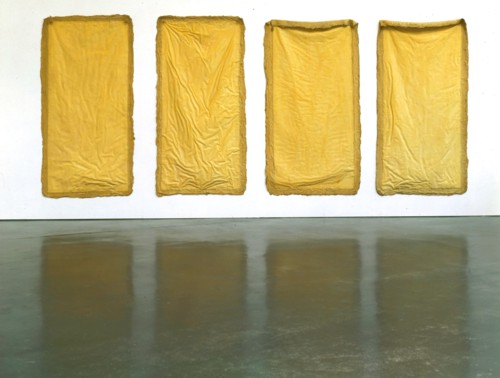
Aliza Shvarts, a Yale art major has decided on something peculiar and controversial for her senior art project. As reported by the Yale Daily News Shvarts has decided to document her nine-month process of artificially inseminated herself "as often as possible" while periodically taking abortifacient drugs to induce miscarriages. She plans to display her relics of the piece by showing video recordings of these forced miscarriages as well as preserved collections of the blood from the process.
Needless to say, the project got national attention and sparked much debate. While it was recently reported that Shvarts was supposedly faking the whole process or re-titled as "creative fiction" by Yale university, the piece brings up an interesting question of when, if ever, can art go too far? Are there boundaries to art when it comes to as one student from Yale stated as, "manipulating life for the benefit of her art"? Without any applicable normative aesthetic to determine what is or isn't art(please argue this..please?!), the question remains if all morality and/or ethnics are also absent from art today as well.
My immediate impulse would be yes. Academically, there seems to be an emphasis on the relativity of morality depending upon what eachh culture we are specifically examining. We are taught to recognize and respect these cultural differences. However, issues do arise. International human rights efforts often encounter problems and/or lack of support when it comes to bringing up issues such as female genital mutilation. While one may be hard pressed to find someone who would actually argue PRO for this, it isn't completely unthinkable to devise an argument which would be founded in a tolerance for such practices in order to not project one's culture,and all the norms and morals that go with it, onto this 'other' culture.
The point is if we look at art then it is easy to see such application of certain ethical standards to have deteriorated due to the arrival of a sort of "liberalism" (i guess...) which emphasizes (may be too much) a tolerance for all people, their way of life and practices. On paper it sounds great. However, when you get into issues like FGM, it becomes a problem. The same goes for art. Anything goes, right? Well, what about Ms. Shvarts?
Personally, I don't have a problem with Ms. Shvarts piece. Actually, I find it fascinating and all that much more disappointing that she actually DIDN'T go through with it. I think her piece speaks to the fascination and sort of "mysticism" if you will of the female body that still exists in today's society.
In addition, art already has a long history of artists who have utilized, manipulated and damaged their bodies for art. Marina Abramovic, Chris Burden, or Tehching Hsieh are a few performance artists who immediately come to mind. Their work was much more taxing on the body than Shvarts proposed piece. Even artists like Eva Hesse who worked with toxic material all her life have sacrifice health for their projects. There doesn't seem to be too much of an issue with these artists because they are not hurting(usually) anyone else in the process. However, what happens when we actually do cross that bridge and effect others? Unwillingly? Are we violating an 'ethics' of art? Or does, and if not should, such a thing still exists?
Costa Rican artist Guillermo Vargas ‘Habacuc’ sometime last year in a gallery in Managua tied a dog up in a gallery, put it on display, then let it starve to death. As reported, People entered and left, day in and day out. The dog remained without water or food and eventually gave up the ghost. The artist has said a number of different things about the piece. Most of what is said refers back to the situation of massive amounts of stray dogs that are throughout the major cities of Costa Rica. One statement the artist suggest that if he had not captured this dog and tied him up he would of died anyways and no one would of noticed. (Google his name for more. Its hard to get a good link to anything that isn't completely biased). Recently, his name has blown up all over the Internet again because he has been invited to reenact the piece in Honduras.
Now, I am an animal lover and yes I find this disturbing. However, apart of me feels that this is an overly-hyped issue that roots back to our westernized, first-world attitudes towards animals and pets. Frankly, animal rights would probably seem like a pretty absurd movement in most third world countries where huge portions of the population are going without food. However, I don't want to go so far as the fully back that assumption so rather I will stick with what I know which is that we, in this country, have the privilege to even have pets. Our attitudes towards domesticated cats and dogs is much different than some countries. And while this piece probably wouldn't fly in the U.S., it certainly seem to go over relatively acceptable in Costa Rica.
So in regards to art, which seems to be without any borders or if it does have borders damn are they fucking broad, do we accept this? And if we don't accept this then under what pretext do we make that judgment call? That it is unethical? That it is morally wrong? If so, then what are exactly are those ethics that we must abide by in art? And if we do make that judgment then I find it imperative to take into account cultural and moral relativity? And furthermore if you are a liberal, progressive, open-minded individual who supports the application of such relativism then by what means do you make that judgment without becoming hypocritical?
I don't like the piece. However, I find it difficult to extract an argument against it that isn't rooted in my own subjective and emotional objection to it. I would almost rather argue against this relativity, and for a moral standard ,than try and argue against the piece within the definitions of such.